


Fiber optic communication is one of the most important high-speed data transmission technologies in today’s information society. Communication fiber optic cables use light as the information carrier, transmitting digital signals in the form of light pulses through extremely thin glass or plastic fibers, achieving ultra-long-distance, high-bandwidth, and low-loss data transmission. Compared to traditional copper cables (such as twisted pair or coaxial cables), fiber optic communication has completely transformed the global telecommunications landscape.
From internet backbone networks and subsea cables to urban broadband access, 5G base station backhaul, and data center interconnections, fiber optics are virtually omnipresent. They support modern applications such as cloud computing, big data, streaming media, high-definition video conferencing, telemedicine, online education, and the Internet of Things. Without fiber optic communication, today’s global digital economy would be unsustainable, and many daily activities (such as real-time video calls, cloud gaming, and online shopping) would become slow or impossible.
This article provides a comprehensive and systematic introduction to the history and development of fiber optic communication, the role of fiber optics in communication, basic structure, working principles, types and classifications, system components, advantages, challenges, and wide-ranging applications. Through detailed explanations and examples, it aims to give readers a complete and profound understanding of communication fiber optic cables.
History and Development of Fiber Optic Communication
The birth and development of fiber optic communication represent one of the greatest achievements in 20th-century scientific and technological history. From theoretical conception to practical application, it took only a few decades to completely revolutionize human information transmission.
Early Theoretical Foundations (19th Century to 1960s)
The principles of fiber optic communication can be traced back to the 19th century. In the 1840s, Daniel Colladon and Jacques Babinet independently demonstrated the phenomenon of light guiding in water streams or glass rods. In 1880, Alexander Graham Bell invented the “Photophone,” which used sunlight to transmit voice signals through the atmosphere. Although limited in distance, it was the first proof that light could serve as a communication carrier.
In the early 20th century, optical fibers were used in medical endoscopes and similar applications, but attenuation was extremely high (thousands of dB/km), making them unsuitable for communication. The true breakthrough came in 1966 when Charles K. Kao, a Chinese scientist working in the UK, published the paper “Dielectric-Fibre Surface Waveguides for Optical Frequencies” at Standard Telecommunication Laboratories. He theoretically demonstrated that by increasing the purity of silica, fiber attenuation could be reduced to below 20 dB/km, making it viable for long-distance communication. This prediction laid the foundation for modern fiber optic communication. Kao is known as the “Father of Fiber Optics” and was awarded the Nobel Prize in Physics in 2009.
Key Technological Breakthroughs (1970s)
In 1970, Corning Glass Works in the United States developed the world’s first low-loss optical fiber with attenuation of only 20 dB/km, confirming Kao’s theory. That same year, Bell Laboratories invented room-temperature continuous-wave semiconductor lasers and efficient photodetectors, making the generation and detection of optical signals practical.
In 1977, the first commercial fiber optic communication system was deployed in Chicago, USA, for telephone signal transmission at a rate of just 45 Mbps, but it already demonstrated the superiority of fiber over copper.
Explosive Growth (1980s–1990s)
In the 1980s, fiber optics began large-scale deployment. In 1988, the first transatlantic subsea cable, TAT-8 (Transatlantic Telephone Cable 8), was completed, spanning approximately 6,500 km and using fiber optics to transmit 40,000 voice channels—a massive leap forward at the time.
The 1990s saw the most critical advancement: the invention of the erbium-doped fiber amplifier (EDFA) in 1987 (independently developed by the University of Southampton in the UK and Bell Laboratories). EDFA enabled direct amplification of optical signals in the 1550 nm window without optical-electrical-optical conversion every few tens of kilometers. This extended the transmission distance of a single fiber from tens of kilometers to thousands of kilometers, dramatically reducing long-haul communication costs.
At the same time, wavelength-division multiplexing (WDM) technology matured, allowing multiple wavelengths of light to travel simultaneously in the same fiber, multiplying capacity. By the late 1990s, the explosive growth of the internet made fiber optics the dominant medium for backbone networks.
Maturity and Widespread Adoption in the 21st Century (2000s to Present)
In the 2000s, dense wavelength-division multiplexing (DWDM) systems entered commercial use, pushing single-fiber capacity from hundreds of Gbps to the Tbps level. Fiber-to-the-home (FTTH) began large-scale deployment in Japan and South Korea, delivering hundreds of megabits or even gigabit broadband.
In the 2010s, coherent optical communication technology (combined with digital signal processing, DSP) became mainstream, supporting higher-order modulation formats (such as QPSK and 16QAM), raising per-wavelength rates from 10G to 100G and 400G. Data centers also widely adopted multimode fiber interconnections.
Today, fiber optic communication is highly mature, with over 5 billion kilometers of fiber deployed worldwide and more than 1.5 million kilometers of subsea cables carrying over 99% of international internet traffic. Technology continues to evolve, with successful trials of 800G/1.6T transmission and multi-core fibers entering commercial use.
The history of fiber optic communication is a story of humanity continuously breaking transmission limits, replacing traditional copper-based communication in just over 50 years.
The Role of Fiber Optics in Communication
Fiber optics serve as the core “information highway” in modern communication systems. Their fundamental role is to convert electrical signals into optical signals for long-distance, high-speed, interference-free transmission, and then convert them back to electrical signals.
First, fiber optics offer enormous bandwidth potential. A single fiber has a theoretical capacity exceeding 50 Tbps—or even hundreds of Tbps—far beyond the physical limits of copper. This makes fiber the preferred medium for internet backbones, international subsea cables, metro networks, and access networks. Currently, over 90% of global international data traffic travels through subsea fiber optic cables, such as the latest 2023 deployments like 2Africa, which support hundreds of Tbps.
Second, fiber enables ultra-low-loss long-distance transmission. In the 1550 nm window, high-quality single-mode fiber has attenuation of only 0.18–0.22 dB/km, meaning signal loss is less than 5% over 100 km. Combined with optical amplifiers, transoceanic transmission without repeaters is possible. In contrast, copper cables suffer rapid attenuation at high frequencies, requiring amplifiers every few hundred meters or becoming unusable after a few kilometers.
Third, fiber has exceptional immunity to electromagnetic interference. Transmitting light rather than electricity, it is unaffected by electromagnetic waves, radio frequency interference, or lightning. This is particularly valuable near high-voltage power lines, along railways, near airport radars, or in heavy industrial environments. In military applications, fiber can withstand electromagnetic pulses (EMP) from nuclear explosions.
Fourth, fiber offers extremely high security. Traditional copper cables can be tapped inductively via electromagnetic induction, while tapping fiber requires physical access to the core (causing detectable attenuation). Fiber is therefore widely used in government, financial, and military secure communications.
Finally, fiber is compact and lightweight. A typical cable, only a few millimeters in diameter, can contain 144 to 6,912 fibers and weighs far less than equivalent-capacity copper cables. This saves duct space, reduces bridge loads, and lowers deployment costs—especially valuable in densely populated urban areas with limited underground infrastructure.
In summary, fiber optics are not only the physical foundation of high-speed communication but also the critical infrastructure supporting the digital economy, information society, and global connectivity.
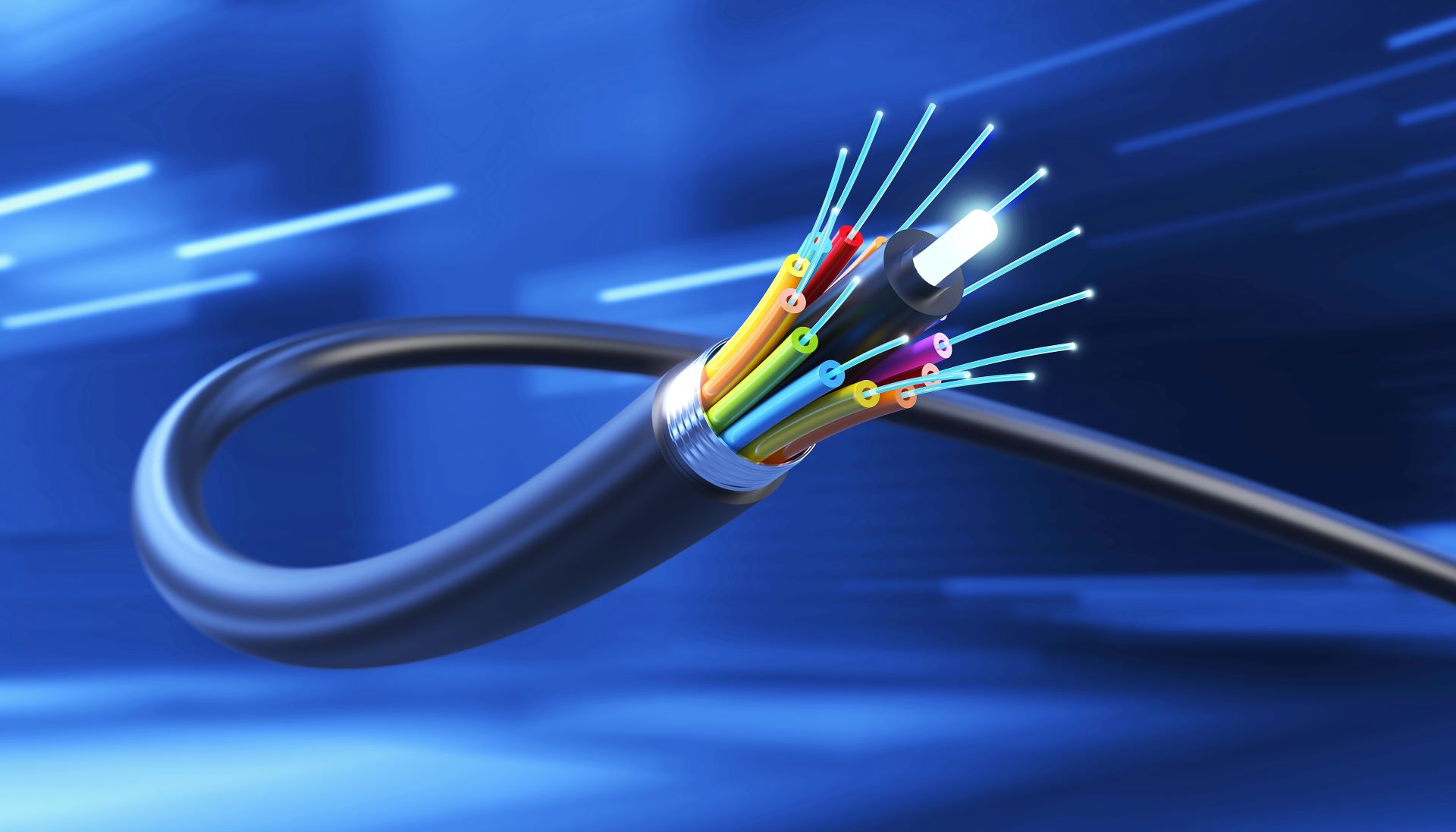
Basic Structure of Fiber Optics
Communication fiber optic cables are not simple glass strands but precise multi-layer composite structures. Understanding their structure is essential to grasping their operating principles.
Core Components of an Optical Fiber
A typical optical fiber consists of three main parts:
- teras The core is the pathway for light signal transmission, made of high-purity silica (SiO₂) doped with germanium (GeO₂) or other materials to increase refractive index. Single-mode cores are typically 8–10 μm in diameter; multimode cores are 50–62.5 μm. The core must be extremely pure (impurities less than one part per billion) to minimize attenuation.
- Pelapisan The cladding tightly surrounds the core with a standard diameter of 125 μm and is made of pure silica with a slightly lower refractive index (difference of about 0.1%–1%). Its primary role is to confine light within the core via total internal reflection while providing mechanical protection and optical isolation.
- Coating The coating is a dual-layer acrylate plastic protection (typically 250 μm diameter: primary and secondary coatings). It absorbs shocks, prevents microbending loss, and protects against moisture and chemical corrosion. The coating makes bare fiber (core + cladding, 125 μm) robust and handleable.
Overall Structure of Fiber Optic Cables
A single fiber is extremely fragile (breaking at bend radii of a few millimeters), so multiple fibers are combined into cables. Typical structures include:
- Fiber Units: 2–12 coated fibers (color-coded) loosely or tightly bundled around a central strength member.
- Ahli Kekuatan: Central steel wire or fiberglass-reinforced plastic (FRP) providing tensile strength (up to thousands of newtons).
- Water-Blocking Materials: Water-blocking yarn or gel to prevent longitudinal water penetration.
- Sheath: Outer layer of polyethylene (PE), low-smoke zero-halogen (LSZH), or polyvinyl chloride (PVC) for water, UV, and rodent resistance.
- Armoring (in some cables): Steel tape or wire armor for direct burial or seabed cables to resist mechanical damage and shark bites.
Depending on the environment, cables are classified as outdoor aerial (ADSS all-dielectric self-supporting), duct/direct-buried, submarine, indoor, or field-deployable. Submarine cables are the most complex, with double armor and multiple sheaths, weighing several tons per kilometer.
Working Principles of Fiber Optics
The fundamental principle of fiber optic transmission is total internal reflection and waveguide effects.
Total Internal Reflection
When light travels from a higher refractive index medium (core) to a lower one (cladding) at an angle greater than the critical angle, it reflects 100% back into the core without refracting into the cladding.
The critical angle is determined by Snell’s law: sin(θ_c) = n_cladding / n_core
Typical values at 1550 nm: n_core ≈ 1.468, n_cladding ≈ 1.463. This tiny refractive index difference allows light to propagate in a zigzag path with minimal energy loss over thousands of kilometers.
Propagation Modes in Fiber
Light propagates in different “modes” (paths):
- Single-Mode Fiber: Very thin core allows only the fundamental mode (HE11), with nearly straight propagation and zero modal dispersion—ideal for ultra-long distances.
- Multimode Fiber: Thicker core supports hundreds of modes with varying path lengths, causing modal dispersion and limiting distance.
Additional dispersion types include material dispersion (different wavelengths travel at different speeds) and waveguide dispersion. Total dispersion must be managed to prevent pulse broadening.
Generation and Detection of Optical Signals
Communication uses near-infrared light (main bands: O-band 1260–1360 nm, C-band 1530–1565 nm, L-band 1565–1625 nm) where silica attenuation is lowest.
- Transmitter: Distributed feedback lasers (DFB-LD) or vertical-cavity surface-emitting lasers (VCSEL for multimode) modulate electrical signals into light pulses via direct or external modulation (Mach-Zehnder modulator).
- Receiver: Avalanche photodiodes (APD) or PIN photodiodes convert photons to current, followed by transimpedance and limiting amplifiers to recover digital signals.
Types of Optical Fibers
Fibers are classified by propagation mode, refractive index profile, and application.
Gentian Mod Tunggal (SMF)
- Core diameter: 8–10 μm
- Characteristics: Low dispersion, low attenuation, long distance
- Main standards:
- G.652: Standard single-mode, most common.
- G.653: Dispersion-shifted, early long-haul.
- G.655: Non-zero dispersion-shifted, suitable for DWDM.
- G.657: Bend-insensitive (bend radius as low as 7.5 mm), used in FTTH.
Multimode Fiber (MMF)
- Core diameter: 50 μm (mainstream) or 62.5 μm (legacy)
- Characteristics: Easy coupling, low cost, short distance (<2 km)
- Standards: OM1–OM5; OM5 supports short-wavelength division multiplexing (SWDM).
Specialty Fibers
- Polarization-maintaining fiber: Preserves polarization for fiber gyroscopes.
- Erbium/ytterbium-doped fiber: For amplifiers and fiber lasers.
- Large effective area fiber: Reduces nonlinear effects.
- Photonic crystal fiber: Hollow-core for ultra-low latency.
Components of Fiber Optic Communication Systems
A complete system includes:
Optical Transmitter
- Laser + modulator + driver circuitry
- High-end systems use coherent transmitters supporting complex modulation (e.g., 64QAM).
Optical Receiver
- Photodetector + preamplifier + main amplifier + clock and data recovery (CDR)
Optical Amplifiers
- EDFA (mainstream, 30–40 dB gain)
- Raman amplifiers (distributed amplification)
- Semiconductor optical amplifiers (SOA, short-reach)
Passive Components
- Connectors (LC/SC/MPO)
- Splitters (for PON)
- Wavelength multiplexers (arrayed waveguide gratings, AWG)
Multiplexing Technologies
- TDM: Electrical-layer multiplexing
- WDM: CWDM (18 channels), DWDM (80–160 channels)
- Latest coherent systems: 800G+ per wavelength, single-fiber capacity >100 Tbps.
Advantages of Fiber Optic Communication
Fiber optic communication has overwhelming advantages over copper, microwave, and satellite systems:
- Extremely High Bandwidth and Capacity: Theoretical single-fiber capacity >50 Tbps; commercial systems already reach tens of Tbps. Copper (e.g., Cat6) tops out at 10 Gbps over short distances. Fiber meets demand growth for decades.
- Ultra-Low Transmission Loss: 0.2 dB/km (1550 nm); with EDFA, transoceanic transmission is possible. Coaxial copper loses tens of dB/km; twisted pair even more at high frequencies.
- Strong Interference Immunity: Completely immune to electromagnetic interference, RF interference, lightning, and EMP. Copper requires expensive shielding with limited effectiveness.
- High Security: Tapping is difficult (requires macro-bending, detectable by OTDR). Copper can be inductively tapped.
- Compact, Lightweight, Resource-Efficient: One cable replaces hundreds of copper cables; raw material is silica (sand), essentially unlimited. Copper is scarce and expensive.
- Long Lifespan and Low Maintenance: >50 years, no corrosion or oxidation. Copper ages and oxidizes.
- Supports All-Optical Networks: Reduces optical-electrical-optical conversions, lowering power consumption and latency. In data centers, fiber interconnects consume far less power than copper.
- Strong Environmental Adaptability: Operates in extreme temperatures (-40°C to +70°C), humidity, and corrosive conditions.
These advantages make fiber the preferred choice for nearly all communication scenarios.
Challenges and Solutions in Fiber Optic Communication
- Connection and Splicing Loss: Splice loss must be <0.1 dB. Solutions: Precision fusion splicers, factory-preterminated connectors.
- Bending Loss: Micro/macrobending causes leakage. Solutions: G.657 fiber, proper cabling practices.
- Dispersion and Nonlinearities: Require management for high-speed long-haul. Solutions: Dispersion-compensating fiber (DCF), DSP compensation, large effective area fiber.
- Initial Deployment Cost: Terminal equipment was expensive. Solutions: Mass production has drastically reduced costs.
- Physical Vulnerability: Easily damaged. Solutions: Kabel berperisai, duct protection.
Applications of Fiber Optic Communication
Fiber optic communication has penetrated every sector:
- Backbone and Subsea Cables: Carry 99% of international internet traffic; companies like Google and Meta build their own subsea cables.
- Metro and Access Networks: FTTH/FTTB delivering gigabit/10-gigabit broadband. Japan and South Korea have FTTH penetration >90%.
- Data Centers: 400G/800G multimode/single-mode interconnects supporting AI training clusters.
- 5G/6G Mobile Networks: Fronthaul (CPRI/eCPRI), midhaul, and backhaul all rely on fiber—irreplaceable for low latency and high bandwidth.
- Power Utilities: Optical ground wire (OPGW) serves as both ground wire and communication link.
- Railways and Highways: Trackside communication and signaling.
- Broadcast Television: Hybrid fiber-coaxial (HFC) networks, fiber-to-the-building.
- Industrial Control and Sensing: Fiber sensors monitor temperature, pressure, and strain in bridges, oil pipelines, and nuclear plants.
- Military and Aerospace: Interference-resistant command systems, aircraft/shipboard networks.
- Healthcare: Endoscopes, laser surgery transmission.
- Smart Cities: IoT, video surveillance, security system backbones.
Fiber optic communication is deeply embedded in every corner of society, serving as the core enabler of digital transformation.
Kesimpulan
Communication fiber optic cables are one of the greatest inventions of the 20th century. By carrying human information exchange in the form of light, they have profoundly changed the world. From historical development to technical principles, from structural components to widespread applications, this article has comprehensively covered the core knowledge of fiber optic communication. Understanding fiber optics is not only the foundation for grasping modern communication technology but also the key to navigating the pulse of the digital era.


 MS
MS  EN
EN  ID
ID  TL
TL  ES
ES  AR
AR  TH
TH  VI
VI  SW
SW  AM
AM  ZH
ZH