


In the high-stakes world of fiber optic networking, where data speeds reach 1.6T Ethernet and port densities push the limits of physical space, multi-fiber connectors like MTP and MPO have become indispensable. These MTP MPO connectors enable parallel optics, allowing 8, 12, 16, 24, or even 32 fibers to be mated in a single ferrule, powering everything from hyperscale data center interconnects to high-performance computing clusters and 5G backhaul.
But here’s the question that plagues network engineers, procurement teams, installers, and operators in 2026: What are the differences between MTP and MPO connectors? Are they interchangeable, or does one hold clear advantages? The confusion stems from their similarities — both are multi-fiber push-on (MPO) style connectors used in MTP MPO cable Dan MTP MPO fiber assemblies — but the nuances in design, performance, and reliability can make or break a deployment.
This comprehensive guide explores the key differences between MTP and MPO connectors. We start with their definitions and historical context, delve into physical and mechanical distinctions, compare optical performance metrics, analyze applications and compatibility, examine cost implications, and conclude with practical advice for selection in 2026 networks.
Authored by Dekam Fiber — a leading manufacturer of both MPO and MTP assemblies serving global operators — this article provides data-driven insights to help you choose the right connector for your MTP MPO cable Dan MTP MPO fiber projects.
1. Defining MTP and MPO Connectors: Origins and Fundamentals
To understand the differences between MTP and MPO connectors, we must first define each and trace their origins.
Itu MPO connector (Multi-fiber Push-On/Pull-off) is the generic, open-standard multi-fiber connector defined by IEC-61754-7 and TIA-604-5 (FOCIS-5). It was developed in the 1990s by NTT (Japan) as a compact way to connect multiple fibers simultaneously, addressing the growing need for high-density cabling in telecom and data centers.
Core features of MPO connectors:
- Rectangular ferrule housing 8–72 fibers (12 and 24 most common).
- Two alignment pins (male) or holes (female) for precise mating.
- Push-pull coupling mechanism for quick installation.
- Available in single-mode (APC polish) or multimode (PC polish).
- Polarity types: A (straight), B (reversed), C (pair-flipped).
MPO is the “category” — like saying “USB” for cables. Any manufacturer can produce MPO connectors as long as they meet the standard. This openness has led to widespread adoption in MTP MPO cable Dan MTP MPO fiber assemblies, but it also means performance can vary significantly between manufacturers due to differences in tolerances and materials.
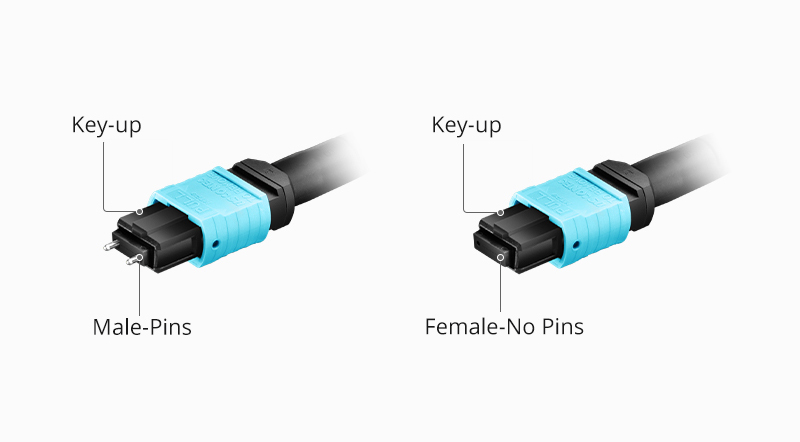
Itu MTP connector (Multi-fiber Termination Push-on) is a registered trademark and proprietary design by US Conec. Introduced in the early 2000s, MTP is a high-performance implementation of the MPO standard, with patented enhancements for better alignment, durability, and optical performance.
Core features of MTP connectors:
- Compliant with MPO standards but with superior engineering.
- Floating ferrule for improved physical contact under stress.
- Elliptical guide pins for tighter tolerance.
- Removable housing for field polarity/gender changes.
- Higher spring force for consistent mating pressure.
MTP is the “premium brand” — like “Thunderbolt” vs generic USB-C — fully interchangeable with MPO but offering measurable advantages in demanding applications. In MTP MPO cable Dan MTP MPO fiber systems, using genuine MTP connectors ensures consistent, high-quality performance.
The key difference: MPO is the standard; MTP is the optimized version. This distinction is crucial when specifying MTP MPO connectors for critical infrastructure.
2. Physical and Mechanical Design Differences
While MPO and MTP connectors look identical from a distance, their engineering variances are substantial and directly impact reliability in real-world deployments.
2.1 Ferrule Design
- MPO: Fixed ferrule with standard composite material.
- MTP: Floating ferrule (moves slightly along the axis) for better physical contact under vibration, temperature changes, or mating stress; high-grade thermoplastic material.
Advantage: The floating ferrule in MTP connectors reduces insertion loss variation by 0.05–0.10 dB, especially in MTP MPO cable subjected to environmental stress.
2.2 Guide Pins
- MPO: Round pins with standard tolerance (±0.005 mm).
- MTP: Elliptical (oval-shaped) pins with tighter tolerance (±0.001 mm).
Advantage: Elliptical pins improve alignment precision, reducing eccentricity errors that cause higher insertion loss in MTP MPO fiber assemblies.
2.3 Housing and Reconfigurability
- MPO: Fixed housing; polarity and gender (male/female) set at factory.
- MTP: Removable housing allowing field changes of polarity (Type A to B) and gender without re-termination.
Advantage: MTP’s removable housing saves significant time and money during installation or reconfiguration of MTP MPO cable.
2.4 Spring Force and Mating
- MPO: Standard spring force for endface contact.
- MTP: Optimized higher spring force for consistent pressure across all fibers.
Advantage: MTP maintains better contact in high-vibration environments, such as data centers with cooling fans or industrial sites.
2.5 Endface Geometry and Polish
Both support PC (multimode) and APC (single-mode), but MTP’s tighter manufacturing tolerances yield superior endface geometry control.
| Fitur | Generic MPO | US Conec MTP® |
|---|---|---|
| Ferrule | Fixed | Floating |
| Guide Pins | Round | Elliptical |
| Tolerance | ±0.005 mm | ±0.001 mm |
| Housing | Fixed | Removable |
| Spring Force | Standar | Optimized |
These mechanical differences make MTP connectors more reliable in high-speed, high-density MTP MPO fiber applications.
3. Optical Performance Comparison
The mechanical enhancements in MTP connectors translate directly into superior optical performance, especially in demanding environments.
3.1 Insertion Loss (IL)
- Generic MPO: ≤0.35 dB typical (multimode), ≤0.50 dB (single-mode APC)
- MTP Standard: ≤0.25 dB typical (multimode), ≤0.35 dB (single-mode)
- MTP Elite (Low-Loss): ≤0.10 dB typical (multimode), ≤0.25 dB (single-mode)
MTP Elite versions are specifically designed for applications where total channel loss budgets are extremely tight, such as 800G/1.6T MTP MPO cable links.
3.2 Return Loss (RL)
- MPO Multimode PC: ≥30 dB
- MPO Single-mode APC: ≥60 dB
- MTP Multimode PC: ≥35 dB
- MTP Single-mode APC: ≥65 dB
MTP’s better alignment and contact improve return loss by 5–10 dB, reducing signal interference in MTP MPO fiber systems.
3.3 Repeatability and Durability
- MPO: ≤0.2 dB variation over 500 mating cycles
- MTP: ≤0.1 dB variation over 1000+ mating cycles
MTP connectors last longer in environments with frequent reconfigurations.
3.4 Temperature Stability
Both operate from –40°C to +85°C, but MTP’s floating ferrule and optimized spring maintain contact better during thermal expansion/contraction, reducing loss variation in outdoor or industrial MTP MPO cable deployments.
4. Applications and Use Cases: Where Each Connector Excels
4.1 MPO Connector Applications
- 40G/100G Legacy Systems: Cost-effective for QSFP SR4/LR4 in enterprise networks.
- Budget-Constrained Projects: Generic MPO connectors for campus LAN or small data centers.
- Short-Reach Multimode Links: OM4/OM5 for distances under 100 m where loss budgets are forgiving.
4.2 MTP Connector Applications
- Hyperscale Data Centers: MTP Elite for 400G/800G SR8/DR8/FR8 with tight loss budgets.
- AI/ML Clusters: MTP for massive parallel optics in GPU farms requiring consistent performance.
- Co-location Facilities: MTP removable housing for frequent moves, adds, and changes (MACs).
- Enterprise 400G Upgrades: MTP for future-proofing with polarity flexibility.
- 5G Fronthaul: MTP for high-density eCPRI connections in urban deployments.
MTP is preferred in >80% of new high-speed deployments due to superior performance in MTP MPO cable Dan MTP MPO fiber systems.
5. Compatibility, Interoperability, and Migration Strategies
5.1 Compatibility Rules
- MTP connectors are fully backward-compatible with MPO adapters.
- MPO to MTP mating: Performance is limited to the MPO level.
- Polarity: Must match Type A/B/C.
- Polish: Never mix PC/APC.
5.2 Polarity Management
- MPO: Fixed polarity set at factory.
- MTP: Removable housing allows field polarity flip (A to B) without re-termination.
Advantage: MTP significantly reduces rework costs in MTP MPO cable installations.
5.3 Migration from MPO to MTP
- Begin with hybrid MTP-MPO cables for gradual transition.
- Replace MPO panels with MTP in new rack sections.
- Full upgrade for 400G+ deployments requiring Elite low-loss.
6. Cost Analysis 2026
6.1 Pricing Breakdown
| Assembly Type (3m, 12-fiber) | Generic MPO | MTP Standard | MTP Elite (Low-Loss) |
|---|---|---|---|
| Multimode OM4 | $18–$32 | $25–$45 | $35–$55 |
| Single-mode OS2 APC | $25–$40 | $35–$60 | $45–$75 |
| 24-fiber Multimode OM5 | $45–$70 | $65–$100 | $70–$110 |
6.2 Cost Drivers
- Elite low-loss versions add 30–50% premium.
- Volume discounts: 20–35% for 10k+ units.
- MTP TCO lower due to higher durability and fewer failures.
The MTP premium (30–60%) is justified by lower loss, longer life, and reconfiguration savings in MTP MPO fiber systems.
Conclusion: Choosing Between MTP and MPO in 2026
Generic MPO connectors remain viable for legacy 40G/100G and budget projects.
But for any new deployment involving 400G, 800G, or high-density parallel optics, MTP® — especially Elite low-loss versions — is the clear winner.
The mechanical superiority, lower loss, higher durability, and field configurability of MTP connectors deliver measurable ROI through higher uptime, easier MACs, and support for next-generation speeds in MTP MPO cable Dan MTP MPO fiber assemblies.
Dekam Fiber offers both: cost-effective generic MPO for value projects and genuine US Conec MTP® Elite assemblies for mission-critical networks.
Contact us for free samples, loss budget calculations, or a customized quotation.
Your high-speed network deserves the best possible connection — don’t compromise on the connector that makes it all work.


 ID
ID  EN
EN  TL
TL  ES
ES  AR
AR  TH
TH  MS
MS  VI
VI  SW
SW  AM
AM  ZH
ZH